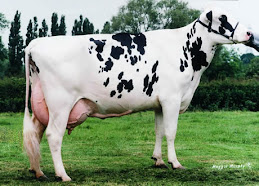
Irish dairy farmers are world leaders in cattle breeding. The key genomes affecting milk production and fertility have been identified by Irish geneticists.
This year’s crop of calves entering cattle breeding stations around the country have been short-listed in part using gene testing with only the most promising being selected for progeny testing. Six spring-born bull calves from the herd of Paddy O’Leary, Conna, Fermoy were genomically selected as potential recruits for Ireland’s cattle breeding industry.
The O’Leary family will host a major Open Day on their farm, as members of the winning group in the ACCBank EBI Discussion Group competition, on Tuesday, 8 September 2009.
"Dairy farmers have been quick to adopt this technology. This year, just months after the technology was developed, genomically selected bulls accounted for one-third of the AI used on Irish dairy farms," said Andrew Cromie, Irish Cattle Breeding Federation. Continuing he said, "Nowhere else in the world has gene testing been so widely adopted as by Irish dairy farmers. Two-thirds of the calves to be born in the herds of the winning Blackwater Discussion Group next spring will have been sired by this new generation of genomically selected AI bulls."
Teagasc Dairy Programme Manager, Matt Ryan said, "Farmers can double the rate of genetic improvement in their dairy herds by using bulls selected with this technology. Our target of an annual herd EBI increase of €5 can now double to €10 per year. If achieved, this herd EBI increase is worth €36 million annually to Irish dairy farmers."
Showing posts with label Teagasc. Show all posts
Showing posts with label Teagasc. Show all posts
Wednesday, September 2, 2009

Wednesday, September 10, 2008
Milk quota situation and meal feeding
Due to the continuous rain in August, cows have lost yield. Nationally what will the milk quota situation be on September 1? Some of our major processors may struggle to fill their milk quota. September is a good month to introduce 2kg of ration to dairy cows. Why? Autumn grass, while it has excellent digestibility and high intake potential, has a lower energy value due to the fact that it is low in water soluble carbohydrate, i.e., sugars. As a result, the response to meal feeding in the autumn is high but the milk yield response achieved will depend on two factors.
The grass allowance to the cows.
The genetic potential of the cow for milk production.
For instance, in a tight grazing situation, allocating 15kg/cow, the milk response rates were similar regardless of genetic potential. A 1:1 response rate was achieved, i.e., a kilogram of milk for every kilogram of ration.
However, if you are allocating 20kg of grass per cow, then the response is reduced to 0.86kg milk per kg of ration fed. Breeds with lower genetic potential for milk yield achieved a response of 0.34kg of milk for each kilogram of ration fed. Clearly this is a loss-making situation.
Meal feeding in the autumn also has the potential to push too much grass ahead of cows, so care is needed.
The grass allowance to the cows.
The genetic potential of the cow for milk production.
For instance, in a tight grazing situation, allocating 15kg/cow, the milk response rates were similar regardless of genetic potential. A 1:1 response rate was achieved, i.e., a kilogram of milk for every kilogram of ration.
However, if you are allocating 20kg of grass per cow, then the response is reduced to 0.86kg milk per kg of ration fed. Breeds with lower genetic potential for milk yield achieved a response of 0.34kg of milk for each kilogram of ration fed. Clearly this is a loss-making situation.
Meal feeding in the autumn also has the potential to push too much grass ahead of cows, so care is needed.
Subscribe to:
Posts (Atom)