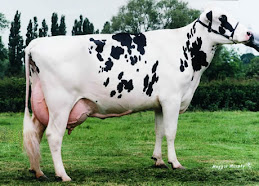
"Celebration of 60 years of Black & White breeding"
The Irish Holstein Friesian Association, IHFA had a very successful Open Day at the Monamore Herd of Tom & Rhona Kelly and family on Wednesday 24th June 2009.
It was a very successful day with the cream of Dairy farmers and breeders from Cork to Donegal attending. There were many breeders from N. Ireland UK and International visitors. It is estimated that over 2,000 attended the event. The weather was lovely and despite the present doom and gloom over milk prices there was a great buzz in the place. There were a large number of commercial stands. Lely featured their latest innovation in Robotic milking machines.The National Dairy Council gave nutritional advice on their stand with a novely penalty shoot out to keep children occupied.
Tom established the Monamore herd in 1979 with some of the great family names such as Torch, Bunty, Fedora, Vera, ... from his late father's JJ Kelly's famous herd the "Moneymore Herd". Coincidentally it is 60 years since the foundation of the Moneymore herd and some of the great foundation cow families still thrive in the Monamore herd to this day.
Tom purchased some of the top International cow families such as Miss America, Roxy, Darlene, Lulu, Goldrose.. to broaden the base of the herd and he has successfully bred these families to achieve his breeding goals.The herd supplies of 220 cows and followers supply milk for liquid consumption to Winter. All feed where possible is homegrown. The herd average for 2008 is 9,800 milk kgs @ 3.64% Fat, 3.35% Pr Classification socres: 60 EX 105 VG.
There was a varied schedule of events with interesting topics and events for all dairy farmers.The Open Day commenced with an Opening address from Mairead Lavery, Chairperson of Agri Aware and editor of country Living Magazine in the Irish Farmers Journal. She stressed the importance of keeping the consumer informed on Quality Irish food and improving the image of Irish farming, also the contribution farmers make to the quality of life in the countryside and the environment. This was followed with the traditional Interclub Stockjudging. There were Junior, Intermediate and Senior teams from 16 clubs including a team from Northern Ireland.
The Master Judges for the day, Ken Proctor, Paul Hannan and Ricky Barrett then gave their reasons for their placings. This was followed by a presentation of the heifers by Alan Dorrian, Herdsman at Monamore.
Tom presented the remaining classes giving details on background breeding and production.
Longlife Cows at MonamoreFollowing on was a special presentation of 6 cows from the various cow families developed at Monamore namely Torch, Breeze, Lulu and Darlene They tipify what this great Black & White breed is all about. These are durable, longlife, fertile cows that are capable of producing large volume of milk with excellent solids and breed back in calf every year.Their lifetime average yield 58245 Kgs Milk , 4165Kgs Fat +Protein ,3.41 %Protein, Average lactation 6. All are classified EX.
There are cows from the Feedora cow family that go back to Volume 1 of the herd book which is celebrating its 100 year anniversity this year.
Tom emphasized the role and services of IHFA of Pedigree Holstein Friesian Registration, Ancestry recording, Linear scoring and Classification in adding value and using best breeding practice of AI and Milk Recording.
Grassland management a key factor in profitability
A very large crowd gathered at the Teagasc forum where the local adviser Tom Lalor along with Dr. Joe Patton Presented the “Grass Wedge” concept of measuring and monitoring grass on all the paddocks on the farm.The cover per cow on Tom’s farm was 186 Kgs which is at the upper end of the range and excellent for high yielding cows. Grass is capable of sustaining 26-28 litres of milk production .This is a key profit component in all milk production systems .
Presentations of Awards
The winners of the National Herds Competition , Interclub stockjudging, Macra Stockjudging and the Diamond and Gold awards for top achieving cows were presented with their prizes.
Celebration Sale
30 lots of young stock with impeccable pedigree were on offer. These represented national and international cow families.There was a buoyant atmosphere with excellent prices on the day.
Celebration BBQ
The evening ended with a celebration barbecue provided by the Kelly family which helped create a carnival atmosphere and an end to a very successful day.
Tuesday, July 14, 2009

Monday, July 13, 2009
Charleville show results
http://www.charlevilleshow.com/Results%202009/Dairy%2082%20-%2098%202009.doc
Link above will give you complete Charleville show results. Congratulations to the Frawleys on a great win with yet another amazing Susie Mist.
Ireland in Praise of EU Dairy Support
The Minister for Agriculture, Fisheries and Food, Brendan Smith TD welcomed the decision of the Milk Management Committee meeting yesterday in Brussels to extend the private storage aid scheme for butter from 15th August, when the scheme would normally close, until 28th February 2010.
The scheme was introduced in January this year, two months ahead of schedule because of the difficult market situation. The Minister also welcomed the publication of Commission proposals aimed at extending public intervention for butter and skimmed milk powder and he will travel to Brussels on Monday to press the Council to support these measures.
Speaking ahead of that meeting, Minister Smith said: "the effect of these measures is such that both public and private storage arrangements will remain in place continuously until August 2010. Even then, should the market situation warrant it, public intervention will remain open until August 2011". The Minister said that these strong signals from the Community reflected the view at high political level of the continued importance of the dairy sector to the EU and its willingness to provide as much support as possible to address the current volatile international dairy market situation.
Minister Smith has been at the forefront in pressing the Commission to activate the full range of market supports and has remained in constant touch with the Commissioner since last November when the APS scheme for butter was first announced. Since then significant progress has been made in utilising the full range of supports.
These have assisted in stabilising the market though the Minister made clear his view that resolving difficulties on the demand side was the key to improving returns to farmers and processors. "I will continue to ensure that the Community market measures play a full role in helping to restore the market to balance and I believe that these new measures should further assist in bringing that situation about".
The Minister pressed very hard during last year's Health Check negotiations for the retention of the market measures that are so crucial now in maintaining balance in the internal market.
Concluding, the Minister said: "While I accept that prices remain at an unacceptably low level I will again take the opportunity to mobilise colleagues in the Council of Ministers for their continued support in favour of actions in the dairy market. Such action is absolutely essential to support the Dairy Sector through a difficult period. I will continue to highlight the need to use in the most effective way possible all Market Management measures".
The Minister will also have a separate meeting with Commissioner Fischer Boel.
Ireland Granted Brucellosis Free Status
IFA Deputy President Derek Deane said the decision by the EU Commission to grant Ireland Brucellosis-free status was welcome, but it was disappointing that the Minister for Agriculture has not returned the full €15m in cost reductions allowable to farmers. Mr Deane said, “the Minister’s announcement represents a missed opportunity to deliver significant savings to farmers, who have played a pivotal role in securing Brucellosis-free status. Farmers will feel let down by the Minister’s failure to reward the sustained efforts of the farming community in achieving this milestone. IFA has identified control relaxation that will bring about major cost reduction for farmers, while at the same time protecting the national herd. These have been presented to the Minister and his senior officials as far back as October, 2008.” Mr Deane said there is no reason why the Minister cannot extend the 60-day pre-movement test to older animals and significantly reduce the level of annual blood testing. He said the Minister must revisit this between now and the implementation of changes. Derek Deane said the Minister can extend the 60 days pre-movement test requirement to only heifers over 24 months and all cows/in-calf heifers. This would represent savings of €5m for farmers, with 350,000 animals in this age bracket sold annually either farm to farm or through marts. Extending the annual herd test requirement to 24 months will represent savings of €2.5m to farmers, but in the current climate, maintaining the annual round test is an unnecessary cost. The milk ring test and cull cow monitoring at factories, combined with minimal blood testing, would provide adequate national monitoring, which would return savings of €7.5m to farmers.
Friday, July 10, 2009
Peter Applebome in the NY Times - sound familliar?
It’s never been an easy life. Up at 4:30 for the first milking, finish up around 8 at night. You make a living, but not much of one, which is why the average age of dairy farmers keeps creeping up into the 50s and 60s. The big payday is when you get out of it and sell your land.
“It’s a profession that if you weren’t born into it, no one would do it,” said Donald Hosking, who with his wife, Joanne, raises 100 Holsteins on 81 lovely rolling acres in Delaware County at the far reaches of the Catskills. “We just don’t know any better.”
So back when they started dairy farming on Roses Brook Road 22 years ago, there were seven other dairy farms on the road. Now one other is still hanging on, and the rest have been sold to lawyers, architects, commodity brokers from the city and suburbs. In 1998, there were 8,700 dairy farmers in New York. Now there are 5,700.
For all the vagaries of markets and weather and balky cows, there used to be a hazy ostensible logic to the business. Now it’s a global market complicated by commodities traders, the balance between imports and exports, the needs of agri-conglomerates, and the role played by strange new players like the imported milk protein concentrates, or M.P.C.’s, which some say are distorting the market with unregulated and potentially unsafe milk substitutes used in cheeses and dips.
But the bottom line seems to be that the global recession slammed the brakes on demand — fewer restaurant visits, less ice cream, less cheese — at a time of peak supply. Two years ago, Mr. Hosking was making about $20 per 100 pounds of milk. Now he’s making about $10.85. Meanwhile his costs — grain, fuel, high-protein feed — have gone up about 50 percent. Last year he took out about $40,000 from savings to keep going. This year it will be about $50,000. Farmers who have tapped out their equity — a growing number — could be gone in months.
“It’s 1973 prices and 2009 costs,” he said. “It still costs X number of dollars to run the farm, no matter what you’re bringing in. Detroit can shut down when their lots are full. We still have to feed and milk our cows every day.”
Dave Rama, who has a cattle auction business in Delhi, said everyone was in the same boat, with the cost of producing milk exceeding its price.
“I am learning more about bankruptcy than I ever intended to learn,” Mr. Rama said.
He drives from Mr. Hosking’s farm to Unadilla, the hills impossibly green from all the rain, grain silos poking into the blue sky. There he meets two of the younger farmers, Luke and Derek Johnson, 32 and 24, Cornell ag achool grads taking over their family farm. There are 300 cows and beehives and fields of corn, the bounty of American agriculture everywhere you turn.
LUKE JOHNSON says he’s always been an optimist, and he figures this will work out, too. He’s lucky to have a highly regarded farm operation, though he worries about his neighbors and already has $300,000 in debt against $500,000 in equity in cows and machinery. Still, he says: “It’s hard to see good farmers desperate. I was just in California at the national Holstein convention, and all the delegates there had desperate looks on their faces, as if they didn’t know what was going to happen next.”
HOBART, N.Y. – It all seems far away. We don’t see where our food comes from, and who could pay attention anyway, what with the endless cavalcade of amusements that’s the summer news — the randy governors and senators, Jon and Kate, poor, put-upon Sarah Palin, the farewell to M.J.? But maybe that’s the idea. In the real world around the corner and in distant places like Hobart and Delhi and Unadilla it’s not getting better and it’s not getting clearer, so bring on the freak shows, the more the merrier.
Mike Van Amburgh is an animal science professor at Cornell who grew up on an Ohio dairy farm. “I’m almost 50 years old, and in my lifetime it’s never been this bad,” he said. “Everyone’s in the red.”
For the dairy farmers, he said, absent a sudden worldwide boom pumping up demand, the most likely result is a historic washout of dairy farmers — some say 10 percent, 20 percent or more around the end of the year — that would reduce supply, raise prices and reset the bar.
Which kind of dairymen, he was asked, are in the biggest trouble?
“Everybody,” he replied.
Last Royal Champion

The last ever Champion Holstein cow at the Royal Show was awarded to Hendomen Arlene 20 jointly owned by Mark Knutsford (Cheshire) and Mike Roberts (Shropshire). The history making animal is sired by Comestar Outside and took Best Udder Award as well as the Holstein Championship. The Royal Show closes its door this week after 170 years owing to financial difficulties.
The third lactation animal was bred by F G Windsor & Sons and proved a popular ringside choice for Holstein judge Mick Gould. Arlene freshened in October 2008 and is currently yielding 55kgs per day and produced over 13,000kgs milk during her second lactation. The 2009 Royal Show Holstein Champion has also produced 9 embryos to Goldwyn.
The Royal Show 2009
Stoneleigh Park, Warwickshire, UK
July 8, 2009
Champion: Hendomen Arlene 20 (Comestar Outside-ET),1st Third Calver, Riverdane Holsteins & M Roberts
Reserve Champion: Riverdane Ladino Sara (Ladino Park Talent-Imp-ET), 1st Second Calver, Luke & Isaac Lancaster
Honourable Mention: Almondene Whitney (Oseeana Astronomical-ET), 2nd Second Calver, Blythe Farms & FR Lawson
Champion Heifer In Milk: Nethervale Jedar Belhazel (Nethervalley Jedar-ET), 1st Junior Heifer in Milk, Luke & Isaac Lancaster
Reserve Champion Heifer In Milk: Aintree Goldwyn Nugget (Braedale Goldwyn), 2nd Junior Heifer in Milk, RW Maddock
Junior Champion: Alderbarrow Samuel Carla (Alderbarrow Samuel-ET), 1st Heifer born May ’08 – July ’08, B & L Whitfield & Sons
Reserve Junior Champion: Wyndford Mr Sam Rebecca 36 (Regancrest-MR Drham Sam-ET), 2nd Heifer born May ’08 – July ’08, RW Maddocks
Champion Bred & Owned: Wyndford Rebecca 13(Wa-Del Convincer-ET), 1st Senior Cow, RW Maddocks
Reserve Champion Bred & Owned: Riverdane Jordan Dellia (Roylane Jordan-ET), 1st Senior Heifer In Milk, Riverdane Holsteins
Subscribe to:
Posts (Atom)